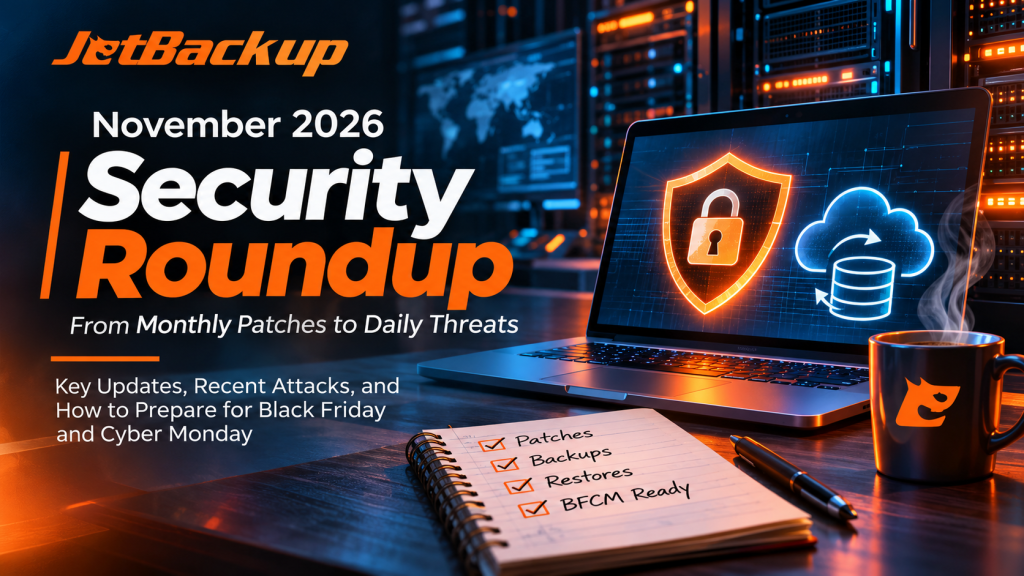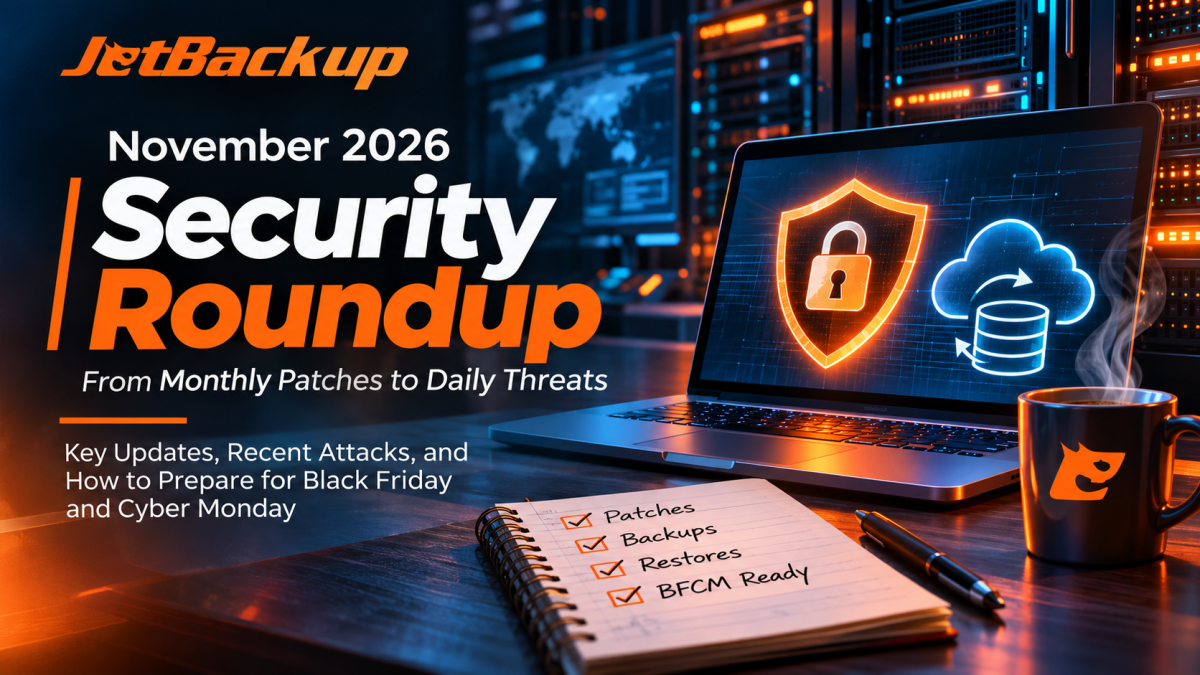
November 2026 Security Roundup: From Monthly Patches to Daily Threats
Throughout 2026, we have been documenting the growing number of security vulnerabilities, exploits, and attacks impacting the web hosting industry. What started as a monthly security roundup has turned into a weekly conversation, and as we move through the final quarter of 2026, it is quickly becoming a daily process.
If you have been following our security roundups this year, you are probably noticing a pattern. We patch, we update, we monitor, and just when we think we are getting caught up, another security advisory lands in our inbox.
November has been no exception. From WordPress and PHP to cPanel, Apache, and NGINX, system administrators have had another busy month. We have also seen another major attack on a hosting provider, once again highlighting the importance of securing not only our hosting infrastructure but also the backups we depend on to recover it.
And just in case your calendar wasn’t busy enough, here comes Black Friday and Cyber Monday!
For many hosting providers and their customers, this is one of the most important weeks of the year. With increased traffic, online transactions, and additional pressure on infrastructure and support teams, the timing of these latest security updates is far from ideal.
WordPress Security Updates Continue
We ended October with the release of WordPress 7.1.4, addressing a remote code execution vulnerability, CVE-2026-119977, impacting the WordPress core update process.
On November 3, the Cybersecurity and Infrastructure Security Agency (CISA) added the vulnerability to its Known Exploited Vulnerabilities catalog, confirming that it was being actively exploited.
What makes this vulnerability particularly concerning is that it impacts the very process we rely on to keep WordPress secure, the update process itself.
Just a few weeks later, on November 18, WordPress released version 7.1.5, addressing another 20 security vulnerabilities, with security fixes also being made available for older WordPress branches.
For those of us in the web hosting industry, managing WordPress updates has become a much larger conversation than simply keeping customers on the latest version.
Hosting providers are managing thousands, and in many cases hundreds of thousands, of WordPress installations, each with its own combination of plugins, themes, PHP versions, and custom development. Every update introduces the possibility of compatibility issues, additional support requests, and potentially downtime.
At the same time, delaying critical security updates introduces another set of risks.
This is where hosting providers have an opportunity to improve the customer experience through automated backups, simplified restores, and better integration between their hosting platform and WordPress.
Giving customers the ability to quickly recover their own websites can reduce the burden on support teams while giving website owners more confidence when performing updates.
As we continue to see an increase in the frequency of WordPress security releases, taking a backup before performing an update should no longer be considered an optional step.
Resources:
Another Round of Critical PHP Security Updates
Following October’s critical PHP security releases, November has brought another round of updates to the programming language that continues to power much of the web hosting industry.
On November 19, the PHP security team released additional security updates, followed by advisories from cPanel and other vendors responsible for maintaining PHP packages across hosting environments.
PHP security continues to be a challenge for hosting providers. While we would all love to see every customer running a fully supported version of PHP, those of us who have worked in hosting long enough know that there is always that one website running an application that hasn’t been updated in years.
Unfortunately, in shared hosting environments, it is rarely just one.
Older applications, custom development, outdated plugins, and compatibility issues continue to make PHP upgrades a challenge for both hosting providers and their customers.
With PHP 8.2 reaching its official end of life on December 31, 2026, now is a good time to start having those conversations with your customers. While extended security support may be available through third-party vendors, hosting providers should have a strategy in place for managing legacy PHP versions across their infrastructure.
There is also an important distinction between the PHP versions offered to your hosting customers and the versions of PHP bundled with the applications and management tools running on your servers.
Updating the PHP version used by your customers does not necessarily mean that every application within your hosting environment has been patched.
As we saw in October, reviewing the software dependencies across your entire hosting stack, including your backup software, is just as important as keeping your customers’ websites up to date.
Resources:
cPanel, Apache, and NGINX Keep System Administrators Busy
The November security updates have not been limited to WordPress and PHP.
Apache HTTP Server 2.4.71 was released this month, addressing three security vulnerabilities. On November 18 and 19, cPanel also announced additional security updates impacting cPanel & WHM and EasyApache 4, including an urgent advisory for its NGINX package.
For shared hosting providers, vulnerabilities within the underlying hosting infrastructure introduce a different level of risk. While a compromised WordPress website may initially impact an individual customer, a compromised server or management platform can potentially impact hundreds or thousands of customers.
This is where the conversation around security needs to extend beyond the technical teams and into the business side of web hosting.
What happens to your business when an entire server goes offline? How many customers are impacted? How many support tickets are generated? How long will it take your team to recover those accounts, and what does that mean for your customer retention?
These are questions that hosting providers should be asking before an incident occurs, not while their support queues are filling up.
Having the ability to restore individual files, databases, hosting accounts, or recover accounts following a complete server failure gives hosting providers the flexibility to respond to different types of incidents without unnecessarily extending downtime.
The faster your teams can recover, the faster they can get back to supporting your customers and growing your business.
Resources:
- Apache HTTP Server Security Advisories
- cPanel & WHM Release Notes
- cPanel Urgent NGINX Security Advisory
When Attackers Target Your Ability to Recover
Earlier this month, we published an article looking at recent attacks on hosting providers and the growing importance of securing backup infrastructure.
On November 2, hosting provider Beget experienced a significant cyberattack that resulted in widespread disruption across its hosting and cloud infrastructure. The company reported that attackers gained access to management systems and deployed destructive malware, leaving its teams with an extensive recovery operation.
The incident is another reminder of how important it is to look beyond the initial attack and understand what happens during the recovery process.
Attackers understand the value of backups. They understand that if a business can quickly recover its data and restore its services, the impact of an attack may be significantly reduced.
For years, the conversation around backups in the hosting industry has focused on where we store our backups, how often we perform them, how much storage we need, and, of course, how much that storage is going to cost us.
Today, we need to be asking a few additional questions.
Who has access to our backups? Can our backups be modified or deleted? Are our backup credentials separate from our production infrastructure? What happens to our backups if our server or management platform is compromised?
Simply moving your backups to the cloud does not automatically make them immutable. Having multiple copies of your backups does not necessarily protect you if all of those copies can be accessed using the same compromised credentials.
Technologies such as S3 Object Lock, immutable storage, two-factor authentication, and independently secured backup destinations are becoming increasingly important components of a comprehensive backup strategy.
The business conversation around backup storage also needs to evolve. While reducing infrastructure and storage costs will always be a priority for hosting providers, the cost of not being able to recover your data can be significantly higher.
Backups are not just another infrastructure expense. They are an investment in the continuity of your business and the businesses of your customers.
Read more:
Black Friday and Cyber Monday: Are You Ready?
Black Friday and Cyber Monday have evolved quite a bit over the years. What used to be a weekend of shopping has somehow turned into a month of sales, with our inboxes serving as a daily reminder that everything we have ever looked at online is apparently on sale.
For the web hosting industry, however, the upcoming weekend remains one of the most important periods of the year.
Increased website traffic, additional transactions, last-minute website changes, new marketing campaigns, and an increase in support requests can put additional pressure on hosting infrastructure.
For eCommerce businesses, every minute of downtime can translate into lost revenue. For hosting providers, that downtime can also translate into increased support costs, customer dissatisfaction, and potentially lost customers.
Now is the time to test your backups and restores, not when your customers are already experiencing downtime.
Before heading into the holiday weekend, we recommend taking some time to review your backup and disaster recovery strategy.
- Verify that your backup jobs are completing successfully.
- Perform test restores to ensure your data is recoverable.
- Review backup schedules for high-traffic and high-transaction websites.
- Confirm that critical security updates have been applied across your hosting infrastructure.
- Review authentication, credentials, and access permissions for your backup destinations.
- Verify your immutable storage and Object Lock retention policies, where applicable.
- Make sure your support and infrastructure teams are familiar with your recovery procedures.
For hosting providers supporting WooCommerce and other eCommerce platforms, it is also important to consider the frequency of your backups.
A daily backup may be sufficient for a traditional website that is updated a few times a month. However, for an online store processing hundreds or thousands of transactions throughout the day, restoring yesterday’s backup could mean losing a significant number of orders and customer records.
Understanding your customers’ recovery point objectives (RPO) and recovery time objectives (RTO) can help you develop backup offerings that better align with their business requirements.
It also presents an opportunity for hosting providers to offer additional backup and recovery services that deliver real value to their customers, rather than simply offering more storage space.
Keeping JetBackup Secure and Up to Date
At JetBackup, security continues to be at the forefront of our development efforts, and our development team has also had a busy November.
Throughout the month, we have rolled out multiple security updates across our JetBackup 5 Release and Edge tiers.
On November 4, we released a critical PHP dependency update addressing CVE-2026-109618 and CVE-2026-109619. This was followed by additional core security updates on November 12, a cPanel integration security fix on November 13, and further core security hardening on November 22.
For customers running our current production Release tier, these core security improvements are available in JetBackup 5.4.1.7.
We encourage hosting providers and system administrators to ensure they are running the latest security updates available for their JetBackup installations and platform integrations.
We are also continuing to develop and test additional security features in the JetBackup 5.4.2 branch, currently available through our Edge tier. These include S3 Object Lock integration and our new Immutable Backups Wizard, designed to simplify the implementation and management of immutable backups.
While these features continue to progress through our release process, JetBackup Storage already offers Object Lock options during bucket creation, providing hosting providers with an additional option for securing their backup data against unauthorized deletion.
With the upcoming holiday weekend, our recommendation is to prioritize the latest production security updates, review your existing backup configurations, and ensure that your recovery processes are working as expected.
Keeping the software responsible for protecting and recovering your data up to date is just as important as keeping your hosting infrastructure up to date.
For the latest information on JetBackup security updates and product releases, visit our JetBackup Changelog.
Backups Are Becoming a Bigger Part of the Hosting Business
Over the past year, through our conversations with hosting providers, partners, and industry leaders, we have seen a shift in how the industry is approaching backups.
The conversation is no longer simply about whether a hosting provider offers backups as part of a hosting package. It is about the quality of those backups, how quickly customers can recover their data, how securely that data is stored, and how much control customers have over their own recovery.
For hosting providers, backups can be a competitive advantage.
Giving your customers the ability to manage their own backups and restores can help reduce support requests. Offering more frequent backups can provide additional value to eCommerce customers. Providing immutable backup options can help address the growing security and data protection requirements of businesses.
These are opportunities to improve the customer experience, increase customer retention, and develop additional revenue streams while helping customers better protect their businesses.
As the hosting industry continues to evolve, particularly with the growth of AI-generated websites and automated website development, the amount of data we are responsible for protecting will only continue to grow.
Our backup and recovery strategies need to evolve along with it.
Looking Ahead to December and 2027
As we approach the end of 2026, one thing has become increasingly clear. The pace of security vulnerabilities, exploits, and attacks impacting our industry is not slowing down.
We started the year talking about monthly security updates. We moved into weekly security updates, and as we close out the year, daily security updates are becoming part of the conversation.
Hosting providers are being asked to patch faster, respond faster, and recover faster, all while continuing to deliver the performance, reliability, and customer experience their customers expect.
We cannot predict where the next vulnerability will be discovered or which application will become the next target. What we can do is make sure that when something does happen, we have the tools, processes, and infrastructure in place to recover.
At JetBackup, we will continue working with our hosting partners and customers to develop the tools that make protecting, managing, and recovering their data easier and more secure.
In the meantime, update your software, review your backup strategy, secure your backup destinations, and most importantly, test your restores.
From all of us at JetBackup, we wish our customers, partners, and friends across the web hosting industry a happy Thanksgiving and a safe, secure, and successful Black Friday and Cyber Monday!
Subscribe to our newsletter
Get expert backup tips, the latest industry trends, and exclusive updates on all things JetBackup. Be the first to know—delivered straight to your inbox.