PressConf 2026 Wrap-Up
Why Backups Are the Most Underrated Revenue Driver in Hosting
The 2026 PressConf focused on Clairity as a singular truth: clear, actionable insights drive real change.
Not just clarity in messaging, but clarity in reality. When agency owners, hosting providers, and product builders sit down together, the conversation moves quickly past surface-level topics and into what actually matters. What breaks in production, what costs money, and what separates a good partner from a risky one.
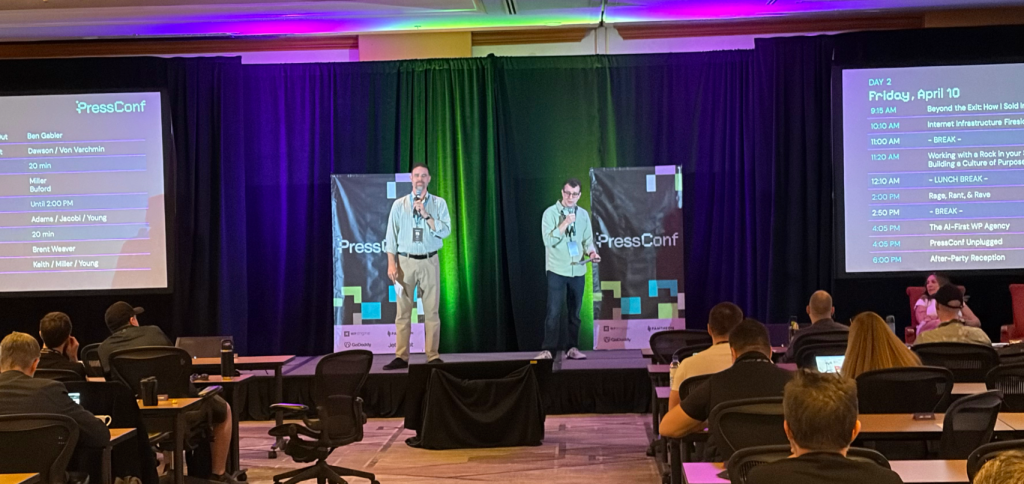
This year, across interviews, hallway conversations, and late-night discussions, one theme kept resurfacing: Backups.
Not as a feature buried in a dashboard, but as a core business decision that directly impacts revenue, trust, and long-term customer relationships.
How One Backup Failure Changed the Agency Mindset
A defining moment from PressConf came during a conversation with Matt Schwartz, CEO of Inspry, a long-running WordPress agency that has spent over a decade building, managing, and scaling websites.
What stood out was not a technical deep dive, but a hard-earned lesson.
It came from a real failure, one that permanently changed how his agency approaches backups.
A Backup Horror Story
Matt recounted a hosting provider losing critical backups, leaving their agency with only a 45-day-old restore point on an active eCommerce site.
That kind of failure does not just create technical problems. It creates financial damage, reputational risk, and long-term distrust.
“From that point forward, we never relied on a single backup system again.”
That mindset is no longer unique. It is becoming standard across agencies that manage serious websites and real revenue. Host-level backups are still part of the equation, but they are never the only layer. There is always a second system, completely independent from the hosting environment, designed to protect against exactly that kind of failure.
Because when something goes wrong, and it will, the question is not whether backups exist.
It is whether they actually work.
The Real Risk Is Not Downtime, It Is Lost Revenue
One of the biggest disconnects in hosting is how backups are positioned versus how they are actually used.
Backups are usually associated with data center outages or server failures. While these events occur, they are not the main concern for agencies.
The real risk is much more frequent and far less visible.
A WooCommerce checkout stops processing orders after an update. A form silently fails and stops sending leads. A small configuration change wipes out recent transactions or breaks part of the user flow. These are not edge cases; they are everyday operational risks that happen across thousands of websites.
“The biggest issue is not that something breaks, it is how much revenue is lost before anyone notices.”
This is why hourly backups were discussed repeatedly at PressConf, especially in the context of e-commerce. For a site generating revenue every hour, reverting to yesterday is not recovery; it is a loss. Every missing order, every failed transaction, every broken form represents real money that cannot be recovered.
The closer the restore point is to the moment of failure, the more revenue is protected.
This is the heart of the argument: Backups aren’t features; they are essential to business viability.
Why Hosting Companies Are Missing the Opportunity
Despite how critical backups are in practice, most hosting providers still treat them as a baseline feature rather than a differentiator.
Instead, the industry continues to compete heavily on pricing. Discounts, promotional offers, and free migration incentives dominate acquisition strategies. While these tactics can attract attention, they rarely build long-term loyalty.
Agencies made it clear at PressConf that price is not the deciding factor.
They do not move hosting providers because something is cheaper. They move when something fails.
“Nobody switches hosting because of price. They switch when something breaks.”
There is an opportunity for hosting providers to elevate backups as a core value. Providing advanced backup options, transparent restore processes, and better backup performance visibility offers not just technical, but strategic advantages.
Backups are not just protection. They are a trust signal.
Backups as a Revenue and Retention Strategy
One of the more practical insights that emerged from PressConf is how backups can be positioned not just as protection, but as a revenue-generating service.
For agencies working with eCommerce clients, the value is obvious. If a website is generating meaningful revenue, then protecting that revenue becomes an easy decision. A small monthly cost for more frequent backups or better recovery options is negligible compared to the cost of lost orders or downtime.
“Ten dollars a month for hourly backups is nothing if your site is doing real revenue.”
This opens the door for hosting providers to rethink how backups are packaged and sold. Instead of bundling them as a hidden feature, they can be offered as a visible, high-value add-on. Hourly database backups during peak sales periods, granular restore points for critical workflows, and clear reporting that agencies can pass on to clients all contribute to a stronger offering.
Once a customer experiences a fast, precise recovery, they rarely choose to go without it again.
That is not just an upsell. That is retention.
The Missing Layer, Backup Alone Is Not Enough
While backups are essential, another important theme emerged at PressConf that adds a second layer to the conversation – Verification.
Restoring a website does not guarantee that everything is functioning correctly. A site may be online, but forms may not submit, checkout flows may still fail, or integrations may not trigger as expected. These are the areas where businesses actually lose money, often without immediate visibility.
“Backups tell you how to recover. Testing tells you if something is broken in the first place.”
This is where the conversation naturally extended into tools like CheckView, a product developed by Matt and his team. CheckView was built to solve a very real agency problem: not knowing when critical website functionality silently fails.
Instead of waiting for a client to report an issue, CheckView actively tests key user flows like form submissions, checkout processes, and logins, ensuring they work as expected on an ongoing basis. It is not about replacing backups, but about complementing them.
Backups let you recover. Testing gives you the ability to prevent prolonged damage.
Together, they create a much more complete operational safety net.
AI Is Accelerating Change and Risk
AI was part of nearly every conversation at PressConf, and while it is clearly driving efficiency and innovation, it is also introducing new risks.
Agencies are building, deploying, and iterating faster than ever before. Code is being generated, modified, and pushed live with less manual review. Automation is interacting directly with production environments in ways that were not common even a few years ago.
This shift increases the likelihood that small issues will slip through and reach live environments.
“AI is helping us move faster, but it also means more things can break.”
In this fast-paced landscape, backups move from a rare safety net to a daily operational need, serving both disaster recovery and ongoing risk management.
Backups Define Trust, Testing Defines Confidence
Agencies are not choosing hosting partners solely on the basis of dashboards or pricing. They are choosing based on how those partners perform when something goes wrong. How fast a site can be restored, how precise that recovery is, and whether anything critical is lost in the process are the moments that actually define the relationship.
“The best hosting experience is not defined by uptime, it is defined by how quickly you recover when something fails.”
But trust alone is no longer enough. As development cycles accelerate and AI introduces more speed into production environments, agencies also need confidence before failure becomes visible. It is not just about recovering quickly; it is about knowing that core functionality is working at all times.
This is where products like Matt’s CheckView fit naturally into the conversation. It extends beyond recovery and into verification, continuously testing the parts of a website that drive real business outcomes. Forms, checkouts, and key user flows are not left to chance or customer complaints; they are actively monitored and validated.
In a faster, more automated web, the combination of reliable backups and continuous testing is no longer optional. Backups ensure you can recover, but testing ensures you do not fall behind in the first place. Together, they create a stronger foundation for hosting, one built on both trust and confidence, where recovery is expected, and failure is caught before it becomes costly.
JetBackup, Redefining Backup from Feature to Foundation
If PressConf made anything clear, it is that backups are no longer a checkbox feature. They are the foundation of trust between hosting providers, agencies, and the businesses they support.
This is exactly where JetBackup fits.
At the hosting level, JetBackup provides the foundation for automated, reliable backups that run seamlessly in the background, giving providers and agencies consistent recovery points without added complexity. These are the backups you depend on when something goes wrong, built directly into the infrastructure where it matters most.
On top of that foundation, JetBackup introduces flexibility through self-service options and JetBackup for WordPress. This is where the safety net comes into play. Agencies and end users can take control, initiate restores, access backup points, and recover quickly without waiting on support or navigating complex systems. It shifts backups from a reactive process to an operational advantage.
Then there is JetStorage.
JetStorage is the vault, encrypted, decentralized, and built for durability. It ensures that backups are not just stored, but protected, separated from the primary environment, and always within reach. When recovery is needed, data is not only safe; it is also instantly accessible, ready to restore without friction or delay.
Together, this creates something more powerful than a traditional backup system.
JetBackup has effectively rewritten the 3-2-1 backup strategy for modern hosting environments. It is no longer just about three copies, two media types, and one offsite location. It is about integrated infrastructure, independent storage, and immediate accessibility. It is about having backups that are not only secure but usable in real time.
In a world where downtime costs money and silent failures cost even more, backups are no longer just insurance.
They are the system that keeps businesses running.
And that is where JetBackup delivers.
Subscribe to our newsletter
Get expert backup tips, the latest industry trends, and exclusive updates on all things JetBackup. Be the first to know—delivered straight to your inbox.