
The Future of Infrastructure Reliability
Modern digital infrastructure has never been more powerful. It’s faster. It’s more distributed. It’s driven by AI.
Artificial intelligence monitors anomalies in real time. Cloud platforms automatically scale workloads without human intervention. Global CDNs move content to the edge in milliseconds. And internet usage continues to expand across every industry, creating enormous opportunities.
But here’s the uncomfortable truth.
The more interconnected the infrastructure becomes, the more fragile it can be.
When one layer fails, every dependency attached to it is affected.
And in 2026, there are many dependencies.
The Expanding List of Cloudflare Outages
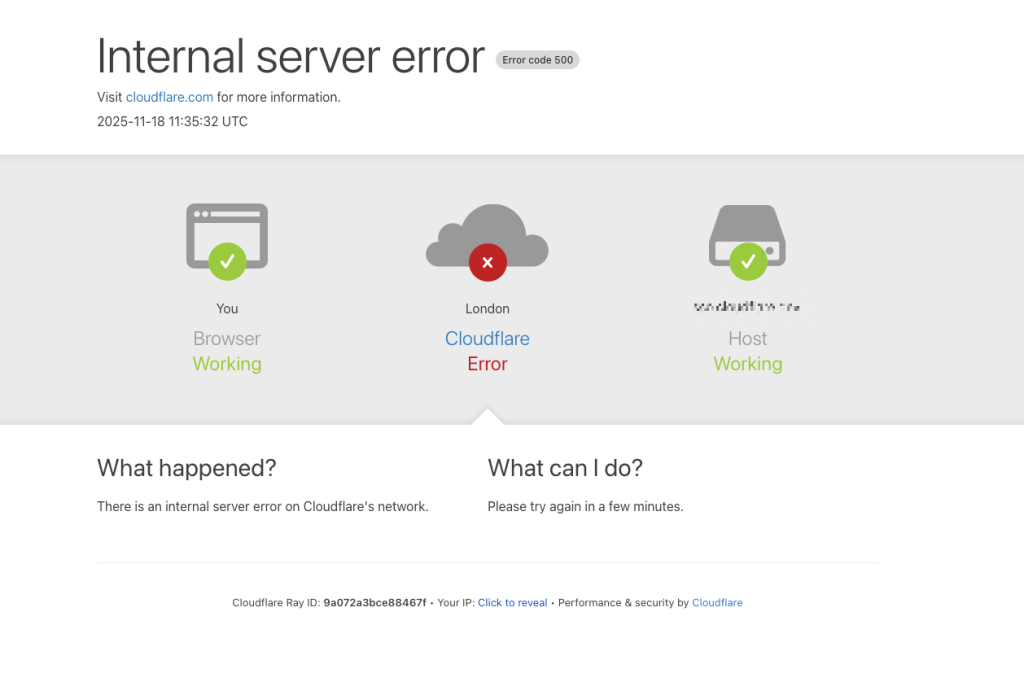
Cloudflare has become foundational to the modern internet. DNS. CDN. DDoS protection. Zero Trust. Edge compute. For many organizations, Cloudflare is the front door to everything.
Which means when it has an issue, the blast radius is massive.
Over the past several years, we’ve seen that reality play out:
- On July 2, 2019, a faulty firewall rule deployment triggered a global outage, taking down large portions of the internet for roughly 30 minutes.
- In July and August 2020, issues with upstream routing and transit providers disrupted connectivity worldwide.
- June 21, 2021, widespread service degradation impacted numerous sites globally.
- June 21, 2022, a significant global outage affected core services and edge locations.
- July 14, 2022, partial European data center disruption.
- Multiple 2023 incidents, including API and dashboard outages that prevented customers from making configuration changes.
And then February 20, 2026.
A significant outage impacted customers using Cloudflare’s Bring Your Own IP, or BYOIP, service. The disruption lasted approximately six hours and was caused by BGP routing failures. The core Cloudflare network remained operational, but specific customer prefixes failed to propagate properly. The result was that certain major websites simply became unreachable.
The network can be “up,” and your site can still be down.
BGP, the backbone routing protocol of the Internet, is incredibly powerful. It is also incredibly sensitive to misconfigurations and propagation failures. Reliability doesn’t just fail at the server level. It can fail at the routing layer.
And when it does, it fails quietly but dramatically.
For more info: https://www.cloudflarestatus.com
When Traffic Becomes the Threat

Not every outage is malicious.
During the 2026 Super Bowl, an AI.com commercial triggered an immediate surge in traffic. Within seconds, users began hitting the domain in massive numbers. Many were greeted with a Cloudflare protection or queue screen instead of the intended destination.
This wasn’t a hack – It was a success.
But in modern infrastructure, success can look exactly like an attack. Viral marketing, product launches, media coverage, and live events generate an explosive burst of traffic. If origin servers aren’t engineered to scale instantly, and caching isn’t tuned correctly, the system buckles. This moment proved that even a $70 million domain and the operational experience behind Crypto.com are no match for unprepared infrastructure when traffic spikes hit.
Traffic planning is no longer optional. It’s part of reliability engineering.
AI vs AI, The New Security Arms Race

Artificial Intelligence now powers predictive monitoring. Systems detect anomalies in milliseconds, automatically mitigate DDoS attacks, and forecast hardware degradation before it becomes catastrophic.
Reliability has shifted from reactive to proactive.
At the same time, attack tooling has become radically accessible.
Launching a distributed denial-of-service attack no longer requires elite expertise. Botnets can be rented. Automation scripts are widely available. Traffic floods can be generated globally with minimal effort. A technically curious teenager today can initiate traffic patterns that can overwhelm unprotected infrastructure.
Security threats like DDoS and brute-force attacks continue to contribute to outages. What has changed is scale and accessibility.
AI is defending infrastructure – it’s also probing it.
The Myth of Perfect Uptime
Many hosting providers advertise 99 percent uptime guarantees. That still allows more than three days of downtime per year.
Hardware fails. Firmware introduces bugs. Routing tables get misconfigured. Cloud control planes malfunction. Even solid-state drives, which fail less often than traditional drives, are not immune to degradation.
Automation accelerates everything, including failure.
A bad configuration can be deployed globally in seconds. A faulty update can instantly cascade across regions. What once took hours to spread now takes moments.
Reliability in 2026 is not about eliminating outages – It’s about minimizing blast radius and recovering fast.
Backups, The Only Real Safety Net
When outages escalate into true disasters, data is what’s at risk.
Ransomware campaigns now target backup repositories directly. Attackers understand that encrypting production systems is only half the job. If they can compromise recovery points, they eliminate your options.
The most critical practice remains unchanged.
Maintain independent, off-site backups that are not stored within your primary infrastructure.
Modern resilience requires immutable backups, multi-region replication, air-gapped storage, and routine disaster recovery testing. Because reliability without recoverability is temporary at best.
Availability means nothing if you can’t restore.
Final Thoughts: Reliability Is Strategic
A Super Bowl advertisement can overload your origin servers.
A BGP routing failure can isolate customer prefixes for hours.
A CDN outage can cascade across thousands of properties.
An inexperienced attacker can trigger a bot-driven traffic surge.
Your customers don’t care about root cause; they care about access.
The future of infrastructure reliability depends on predictive AI monitoring, distributed architecture, routing resilience, layered security controls, and tested backup strategies.
Reliability is no longer a hosting feature. It is a strategic requirement for survival in a permanently connected world.
That is why JetBackup exists and why we have integrated our premium cloud, JetStorage, into our offering.
Because in a permanently connected world, reliability is not just about staying online. It’s about making sure you can always come back.
Subscribe to our newsletter
Get expert backup tips, the latest industry trends, and exclusive updates on all things JetBackup. Be the first to know—delivered straight to your inbox.