WordCamp US 2026: AI, Security, and Why Backup Matters More Than Ever
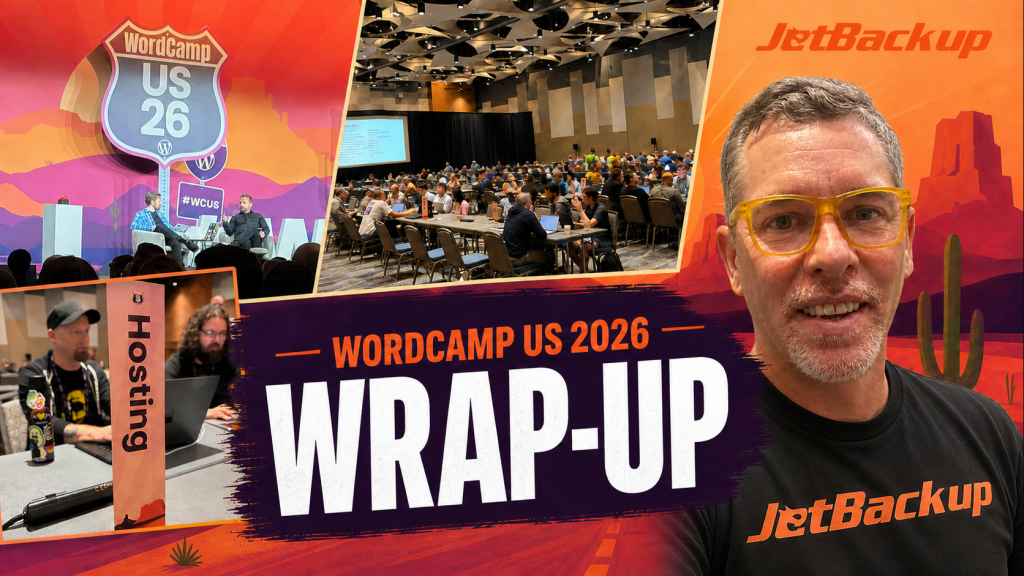
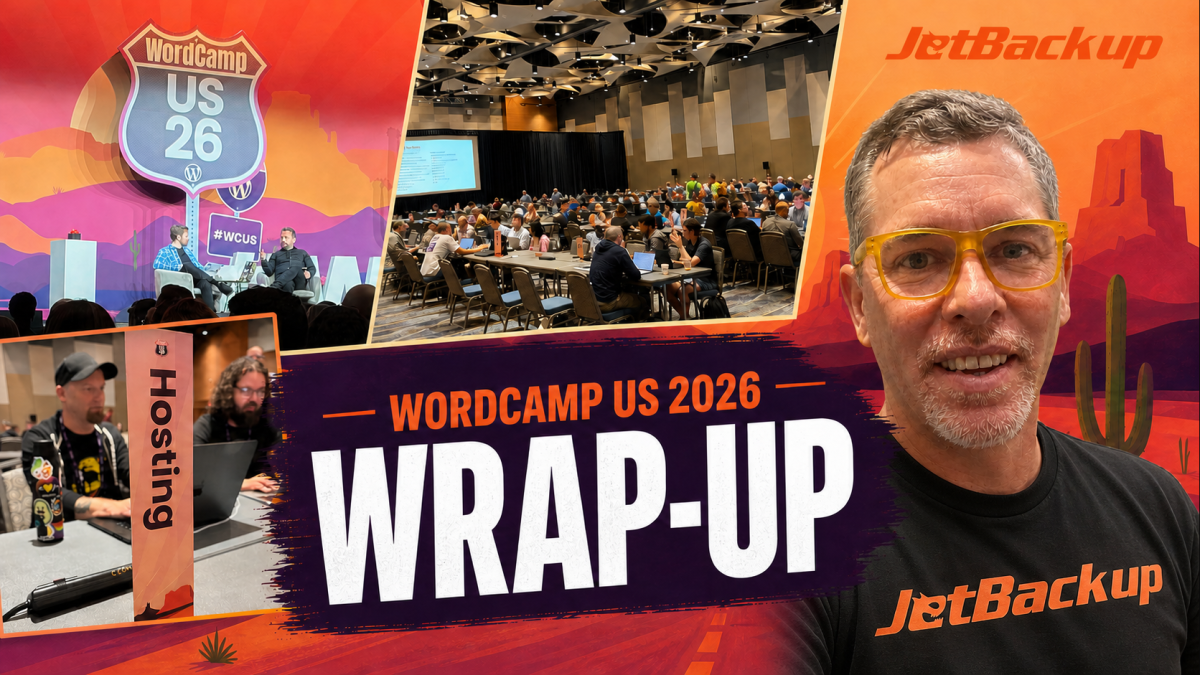
WordCamp US 2026 in Phoenix brought the heat, literally. With temperatures reaching around 114°F, the desert made sure everyone knew exactly where they were. But the real heat at WordCamp US was around AI.
AI was front and center across the event, shaping conversations about development, content creation, automation, support, security, infrastructure, and the future of WordPress itself. For JetBackup, one thing became increasingly clear, as AI becomes more powerful and more deeply connected to production systems, backup and disaster recovery become even more critical.
Contributor Day Set the Tone
Contributor Day continues to be one of the most interesting parts of WordCamp US. There was a real hackathon-style energy throughout the day, with contributors working together across different areas of the WordPress project and solving problems collaboratively.
That remains one of the clearest examples of what makes open source communities different. People from competing companies, different backgrounds, and different parts of the ecosystem can sit together and work toward improving the platform everyone depends on.
That collaborative atmosphere carried into the rest of the event. This year, however, many of those conversations were happening against a much larger backdrop, how AI is changing the way software is built, operated, secured, and maintained.
AI Was Front and Center
You could not talk about the future of WordPress in Phoenix without talking about AI. It is already changing how developers write code, how businesses create content, how support teams respond to customers, and how hosting companies automate infrastructure.
The opportunity is enormous, but so is the risk. We are moving toward a world where AI agents may be able to deploy code, modify configurations, access APIs, manage websites, interact with databases, and perform tasks that previously required a human administrator.
When those systems work correctly, they can make teams dramatically more productive. When they do not, the damage can happen just as quickly. An AI agent does not need malicious intent to create a serious problem. A bad instruction, incorrect assumption, compromised credential, misconfigured automation, or unexpected chain of actions can potentially delete files, overwrite databases, change permissions, break configurations, or affect hundreds or thousands of websites at once.
Sometimes AI can simply go off the rails, and that changes the role of backup.
AI Is Also Changing the Security Threat
AI is not only improving productivity for legitimate developers and businesses. Attackers are using the same technologies to accelerate vulnerability research, exploit development, credential attacks, phishing, malware creation, and large-scale automated scanning.
For hosting providers, that creates a difficult reality. The same AI tools that can help administrators manage thousands of sites can also help attackers search thousands, or even millions, of sites for weaknesses. The time between a vulnerability becoming known and attackers attempting to exploit it continues to shrink.
Prevention remains essential, but prevention alone cannot be the entire strategy. Security controls can reduce risk, monitoring can identify suspicious behavior, and AI itself can help detect threats. Still, no system can guarantee that something will never go wrong.
Hosting companies also need to be prepared for the moment when prevention fails and recovery becomes the only thing that matters.
Backup Is Becoming Part of the Security Stack
Traditionally, backups were often treated as an operational requirement. They were there in case a customer accidentally deleted a file, a database became corrupted, or a server failed.
That mindset is changing. In an AI-driven infrastructure environment, backup is increasingly part of the security stack itself because the threat is no longer limited to simple hardware failure or user error.
A modern recovery strategy needs to consider more than just website files. It should include databases, configurations, email, DNS, application data, and the infrastructure components required to actually restore service.
It also means thinking carefully about off-site storage, multiple destinations, access controls, immutability, and protected recovery points that cannot easily be modified by the same compromised systems they are designed to restore.
If an attacker, automation process, or rogue AI agent can delete your production data and your backups at the same time, you do not really have a resilient backup strategy. You simply have another copy of the same problem.
WordPress Is Becoming an Infrastructure Conversation
One of the strongest takeaways from WordCamp US was how much the WordPress conversation is expanding beyond WordPress itself. The application may be WordPress, but underneath it sits an enormous infrastructure ecosystem covering servers, storage, networks, DNS, databases, security, backups, control panels, cloud infrastructure, and automation.
Increasingly, AI agents are going to interact across all of those layers. That means the lines between traditional WordPress companies, hosting providers, cloud platforms, cybersecurity companies, and infrastructure vendors will continue to blur.
For hosting companies, that creates a major opportunity. They are no longer simply selling disk space and bandwidth. They are becoming infrastructure partners responsible for performance, security, automation, resilience, and recovery.
Backup sits directly in the middle of that responsibility.
Conversations Matter More Than Booth Traffic
One of the biggest reasons JetBackup continues attending WordCamps is the opportunity to talk directly with hosting providers, agencies, developers, technology partners, and the people actually operating WordPress at scale.
Some of the most valuable conversations at an event never happen on a stage. They happen in hallways, over coffee, at dinner, or while reconnecting with someone you have worked with for years.
Those conversations help us understand what hosting providers are seeing in the real world, how customers are changing, how infrastructure is evolving, and how security threats are developing. Increasingly, they also revolve around how companies are preparing for an environment where both legitimate users and attackers have access to much more powerful AI tools.
For JetBackup, those discussions are incredibly important because backup technology has to evolve alongside the systems it protects.
A More Focused WordCamp US
The Phoenix Convention Center gave WordCamp US plenty of space, but the event itself felt more focused than some of the larger editions from previous years.
Attendance was around 1,200 people, with roughly a third reported to be first-time attendees. That smaller scale actually worked well from a business and relationship standpoint. It was easier to have meaningful conversations, reconnect with longtime contacts, and meet new people without feeling like every interaction had to happen in passing.
For companies working in hosting and infrastructure, those conversations matter. WordPress does not operate in isolation. Every site ultimately depends on servers, storage, security, DNS, backups, performance, and the people responsible for keeping all of those systems running.
Closing Keynote
Matt Mullenweg’s closing keynote with Robert Jacobi started about 30 minutes late and had a few technical issues, but once the conversation got moving there were some interesting ideas about simplifying WordPress and rethinking parts of the project that have been around for years.
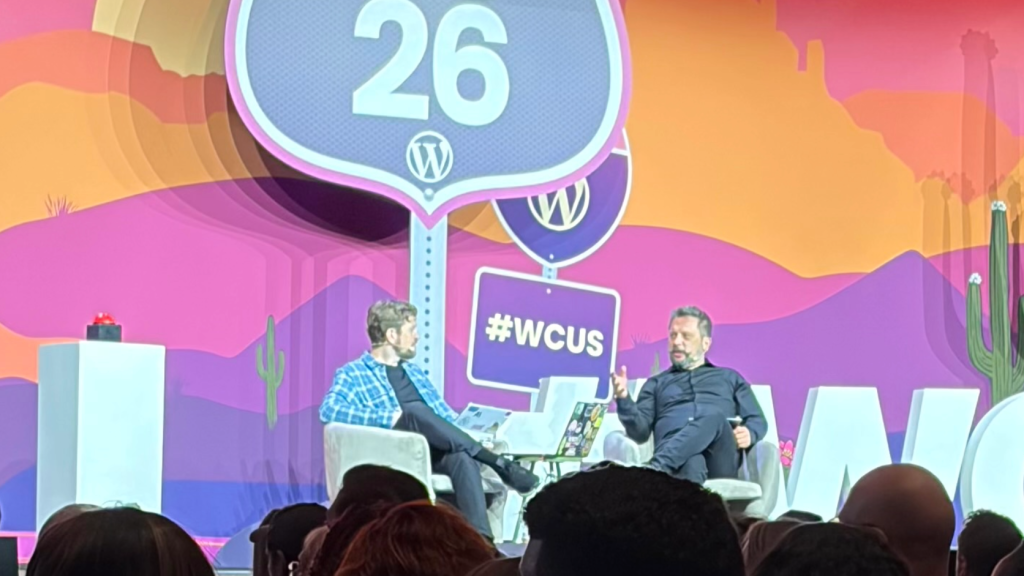
One of the more concrete announcements was around WordPress.org profiles and the new w.org shortcuts. Shorter profile URLs such as w.org/@matt are beginning to roll out, making WordPress.org identities easier to share and potentially more useful across the broader ecosystem.
Matt also talked about changing how WordPress recognizes contribution. Instead of relying mainly on pledged hours through Five for the Future, he discussed putting more emphasis on measurable impact, including commits, tickets closed, posts published, and WordCamps organized.
Another interesting part of the keynote was Piplets, an idea Matt originally experimented with back in 2007. A Piplet is essentially an extremely lightweight application contained in a single PHP file, including its own data, without requiring a traditional database or third-party packages.
Matt suggested that WordPress.org could eventually have a directory where people could publish, fork, and remix Piplets. The idea brings WordPress back toward a simpler, highly portable form of web software and reflects a broader interest in reducing unnecessary complexity.
The audience Q&A also moved into infrastructure, including questions around data centers and the physical systems behind the web. That was especially relevant from a hosting perspective because WordPress may be software, but at its scale it ultimately depends on an enormous amount of infrastructure underneath it.
Servers, networks, storage, power, and data centers are what make the open web actually work. Those conversations are becoming increasingly important as WordPress continues to grow and evolve.
WordPress 7.1 was also released live during the session, with the release leads brought on stage to push the button. It was a fitting reminder that while there was plenty of discussion about where WordPress could go next, the project is still shipping real software and continuing to evolve today.
Closing Out Phoenix
The closing party was enjoyable, although it felt somewhat more subdued compared with some previous WordCamp US celebrations. Past events have featured memorable locations and experiences, while Phoenix’s closing event felt simpler and more contained.
Still, by the end of the week, the most important part of WordCamp US had already happened, the conversations. We reconnected with partners, met new people across the WordPress ecosystem, talked about hosting infrastructure, security, AI, and backup strategy, and came away with a clearer view of where the industry is heading.
The message from Phoenix was difficult to miss. AI is going to create enormous opportunities for WordPress and the hosting industry, but it is also going to create new security threats, new operational risks, and entirely new ways for things to go wrong.
That is why backup matters more than ever. In a world where AI can build faster, automate faster, attack faster, and occasionally break things faster, the ability to recover quickly may become one of the most important capabilities a hosting provider can offer.
For JetBackup, that is exactly where we intend to be.
Subscribe to our newsletter
Get expert backup tips, the latest industry trends, and exclusive updates on all things JetBackup. Be the first to know—delivered straight to your inbox.