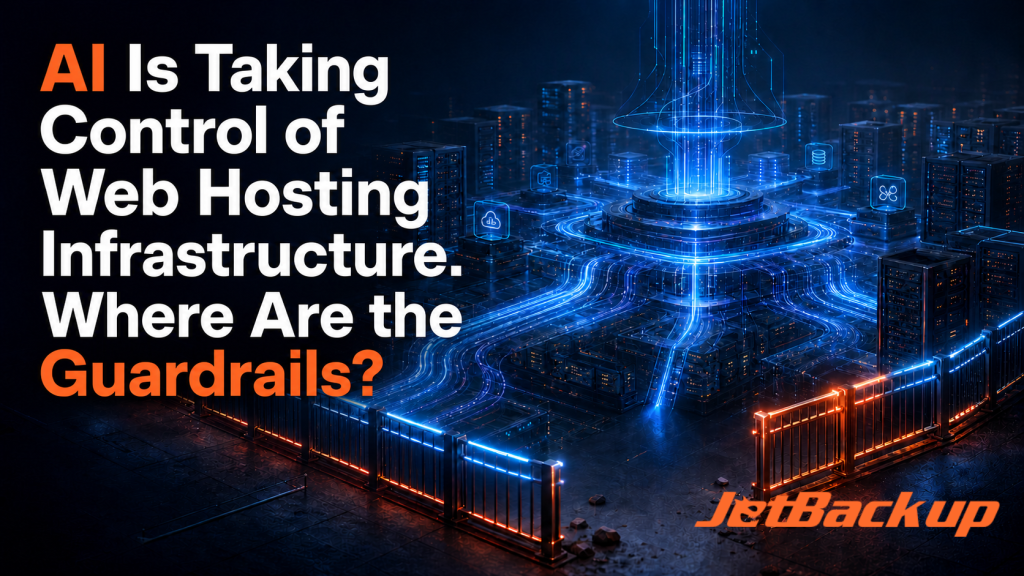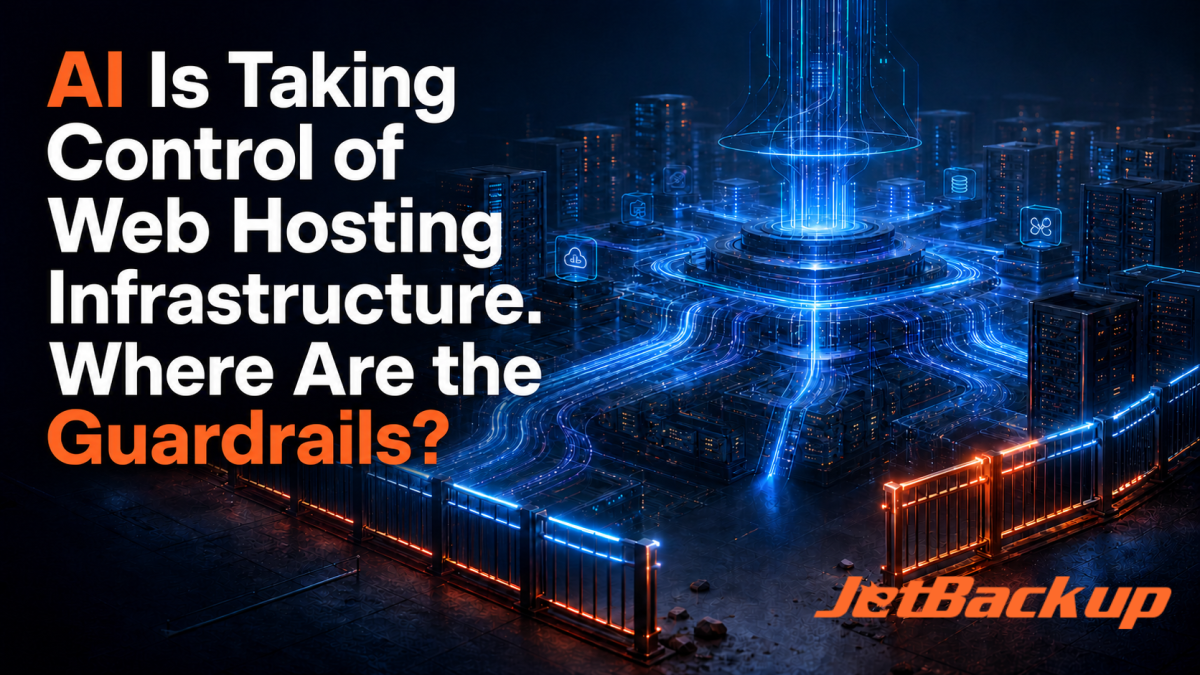
AI Is Taking Control of Web Hosting Infrastructure. Where Are the Guardrails?
The web hosting industry is entering a major shift in how servers and infrastructure are managed. Hosting companies are beginning to experiment with Model Context Protocol (MCP) servers, AI agents, and automated infrastructure management, while control panel companies such as WebPros are moving toward integrating artificial intelligence deeper into the hosting management experience.
The direction is becoming clear. We are moving from control panels that help humans manage servers to AI-powered platforms that can increasingly manage infrastructure on their behalf.
For hosting companies, this could represent one of the biggest changes to managed hosting services in decades. AI agents could deploy applications, troubleshoot server issues, modify configurations, scale resources, optimize websites, respond to support requests, and eventually take action across entire server fleets.
MCP makes this transition even more powerful by creating standardized ways for AI systems to connect with the tools and data required to perform these tasks.
The opportunity for hosting providers is enormous, but so is the potential risk.
As AI gains more control over hosting infrastructure, the industry needs to answer an important question: Where are the guardrails?
AI Agents Are Changing Server and Hosting Management
Traditional hosting automation has operated within relatively predictable boundaries. A customer places an order; the billing platform provisions the account; the hosting control panel creates the environment; monitoring watches the server; and backup software protects the data.
When something falls outside the expected workflow, a system administrator or support engineer usually steps in.
AI agents fundamentally change this model.
Instead of simply executing predefined automation, an AI agent can interpret a request, analyze information, make decisions, call multiple tools, evaluate the results, and then take additional actions to accomplish a goal.
The more hosting infrastructure we connect to AI agents, the more operational authority we potentially give them.
An AI agent could eventually have permission to create servers, resize cloud instances, modify DNS records, access databases, change firewall rules, manage applications, deploy code, or interact with billing systems.
At that point, we are no longer talking about a chatbot answering hosting support questions. We are talking about an operational user with credentials, permissions, and the ability to make infrastructure changes at machine speed.
We are giving the robots the keys to the castle.
Before we do that, we need to make sure we have installed the right locks.
MCP Servers Could Become a Critical Part of Hosting Infrastructure
The Model Context Protocol is quickly becoming an important part of the AI ecosystem because it allows AI models and agents to interact with external tools, services, and data.
For the hosting industry, the potential use cases are significant.
A hosting provider could create MCP connections that allow an AI agent to inspect server health, analyze logs, manage websites, interact with a control panel, provision resources, modify DNS, troubleshoot applications, or perform routine system administration tasks.
This could dramatically expand what hosting companies can automate.
It could also dramatically expand the attack surface.
An MCP server connected to the hosting infrastructure may have access to some of the most powerful tools within the hosting environment. If those permissions are too broad, credentials are compromised, or an AI agent is manipulated into performing an unintended action, the consequences could extend far beyond a single support conversation.
MCP security will increasingly become part of hosting security.
Hosting providers adopting MCP and AI agents should consider permission boundaries, credential isolation, audit logging, rate limits, human approval requirements, and the potential blast radius of each connected tool.
The question should not simply be whether an AI agent can perform a task.
The question should be whether it should be allowed to perform that task autonomously.
AI Can Create Infrastructure Costs at Machine Speed
One of the biggest risks of AI-powered hosting automation may have nothing to do with a traditional security breach.
It could simply be the bill.
Imagine an AI agent tasked with fixing a website performance problem. The agent analyzes the environment and determines that additional resources are required. It increases CPU capacity, adds memory, expands storage, or deploys additional cloud instances.
Technically, the AI solved the problem.
Then the customer receives the bill.
Who authorized the additional spending? Was there a predefined budget? Should the AI have recommended the upgrade instead of automatically executing it? What happens if an agent enters a loop and repeatedly provisions resources while attempting to solve a problem?
Cloud computing already introduced businesses to the concept of bill shock. Agentic infrastructure could amplify that problem because AI agents can consume resources far faster than humans can notice.
AI-powered hosting platforms will need financial guardrails alongside technical guardrails.
That could include spending limits, resource ceilings, rate limits, approval workflows, and automatic shutdown mechanisms. A customer paying $20 per month for hosting should not have an AI agent that can accidentally create a $2,000 infrastructure bill.
The hosting industry has spent decades building technical permissions. The AI era may require us to think just as seriously about economic permissions.
AI Access and AI Authority Are Not the Same Thing
Giving an AI system access to information is very different from giving it the authority to make changes.
An AI assistant that can read server logs and recommend a solution presents one level of risk. An autonomous AI agent that can read those logs, restart services, modify configurations, rotate credentials, change firewall rules, and deploy code presents something entirely different.
Hosting companies need to create clear boundaries between four levels of AI interaction: observation, recommendation, approved execution, and autonomous execution.
Low-risk actions may be safe to automate completely. Other actions should require confirmation from the customer or the administrator. High-risk operations involving billing, security, credentials, data deletion, or major infrastructure changes may always require human approval.
This is where the concept of least privilege becomes increasingly important.
An AI agent should have access only to the systems and actions required to perform its specific task. A website optimization agent probably does not need permission to delete backups. A support agent should not automatically have unrestricted access across an entire server fleet.
The more authority we give an AI agent, the stronger the boundaries around that authority need to become.
What Happens When an AI Agent Makes the Wrong Decision?
AI does not need to be malicious to cause serious damage. It simply needs to make the wrong decision with the right permissions.
A troubleshooting agent could modify the wrong configuration file. An optimization agent could remove something it believes is unnecessary. A security agent could block legitimate traffic. A deployment agent could overwrite production data.
An infrastructure agent attempting to fix one problem could accidentally create several more.
Now imagine those mistakes happening across hundreds or thousands of hosting accounts.
Traditional automation usually fails in predictable ways because developers define the workflow and the actions the automation can perform. Agentic automation introduces decision-making into that workflow, making the possible outcomes more difficult to predict.
Hosting providers will need comprehensive logging and audit trails as AI agents gain greater operational authority.
Every action performed by an AI agent should be attributable, visible, and ideally reversible. Operators should be able to quickly determine what the AI changed, why the change was made, which systems were affected, and what happened afterward.
If answering the question “What did the AI do?” requires digging through five different systems while production infrastructure is offline, the guardrails have already failed.
Prompt Injection Could Become an Infrastructure Security Problem
Prompt injection is often discussed as an AI application security problem, but for hosting providers it could become an infrastructure security problem.
Consider an AI agent tasked with analyzing a website, a support ticket, a repository, a server log, or a configuration file. Somewhere inside that content are malicious instructions designed to influence the agent.
If the AI can only summarize information, the potential damage may be limited.
If the same AI agent can execute commands, modify servers, access credentials, or call infrastructure management tools through MCP, the situation becomes significantly more serious.
An attacker may not need to directly compromise the server if they can manipulate an authorized AI agent into performing the desired actions.
Hosting companies therefore need to treat any information consumed by an AI agent as potentially untrusted input. Agents with infrastructure access should operate under tightly scoped permissions and maintain clear boundaries between the information they can read and the actions they can execute.
The biggest risk may not be an attacker stealing the keys to the castle.
It may be convincing the robot holding the keys to open the door.
Managed Hosting Is Becoming AI-Managed Hosting
Despite these risks, the shift toward AI-powered hosting management is likely inevitable.
Most customers do not actually want to manage servers. They want websites, applications, online stores, communities, and businesses that work reliably.
For decades, hosting companies have tried to make increasingly complicated infrastructure easier to manage through hosting control panels. AI may eventually remove much of the interface between what a customer wants to accomplish and the infrastructure required to make it happen.
Instead of clicking through ten different screens, a customer may simply tell their hosting provider:
“Make my website faster.”
An AI agent could analyze the application, identify bottlenecks, recommend changes, resize infrastructure, configure caching, optimize the database, and validate the results.
That represents an incredibly powerful evolution of managed hosting.
The providers that succeed in this transition, however, may not simply be the companies with the most powerful AI agents. They may be the companies that customers trust enough to give those agents operational control.
Trust will come from transparency, security, predictable costs, clear permissions, and the ability to recover when automation gets something wrong.
Backups Are the Ultimate Guardrail for AI-Managed Hosting
The hosting industry has undergone countless technological transitions. We moved from physical servers to virtualization, from dedicated infrastructure to cloud computing, and from manual server administration to increasingly sophisticated automation.
Through every one of those transitions, one safety net has remained essential: backups.
AI does not change that reality. It makes reliable backups even more important.
An AI agent will eventually delete the wrong file. An automated configuration change will eventually break an application. A deployment will fail. A database could become corrupted. An agent may perform exactly the action it was instructed to perform, only for everyone involved to discover afterward that it was the wrong action.
The most important question then becomes very simple: Can you put everything back?
This is where platforms such as JetBackup become an increasingly important part of the AI-managed hosting stack.
As AI agents gain broader access to production infrastructure, backup systems need to remain separated from the environments those agents control. Hosting providers should consider off-site backup destinations, independent credentials, strong retention policies, multiple restore points, and backup architectures designed to prevent a compromised or malfunctioning agent from destroying the recovery path along with production.
JetBackup enables hosting providers to build backup and disaster recovery strategies across hosting environments while maintaining multiple recovery points and remote backup destinations. As infrastructure management becomes increasingly automated, that separation between production and recovery becomes critical.
AI can automate infrastructure management.
AI can automate troubleshooting.
AI can automate deployments.
AI can automate resource scaling.
But automation should never be able to eliminate your last known good copy.
For hosting providers deploying AI agents and MCP servers, JetBackup should not be viewed solely as another tool within the agentic infrastructure stack. It should be treated as part of the independent safety layer protecting that stack.
The AI agent may be allowed to request a restore. Depending on the environment, it may even be allowed to initiate certain recovery workflows. But unrestricted access to permanently delete every available recovery point should be treated very differently.
The backup system should be one of the hardest systems for an autonomous agent to modify or destroy.
The Future of Hosting Needs AI Guardrails and a Recovery Plan
The next generation of hosting management may not begin with a traditional control panel dashboard. It may begin with a conversation.
Behind that conversation could be AI agents connected through MCP to servers, applications, control panels, billing platforms, security systems, monitoring tools, and support infrastructure.
This could make hosting dramatically easier for customers and allow providers to deliver managed services at a scale that previously required significantly larger operations teams.
It also creates new operational, financial, and security risks.
Before hosting companies give AI agents the keys to their infrastructure, they need to define what those agents can access, what they can change, how much they can spend, which actions require human approval, and how quickly their actions can be reversed.
Most importantly, every hosting provider needs an answer for what happens when the guardrails fail.
Because eventually, one of them will.
When the AI makes the wrong decision, the automation runs out of control, or someone convinces the robot holding the keys to open the wrong door, your final line of defense may not be another AI agent.
It may simply be your last good backup with JetBackup.
Subscribe to our newsletter
Get expert backup tips, the latest industry trends, and exclusive updates on all things JetBackup. Be the first to know—delivered straight to your inbox.